Wildfires have devastated California, and while mainstream media attributes the crisis almost exclusively to climate change, a deeper analysis reveals a far more intricate reality. Evidence drawn from free online sources and firsthand video documentation exposes critical organizational shortcomings, fueling widespread criticism of the local government and its handling of the crisis.
Serious flaws in preparedness and response have come under scrutiny. Critics have pointed to inadequate preventive measures and a disorganized emergency response that left communities vulnerable. A particularly alarming issue has been the logistical breakdown in firefighting efforts, with numerous hydrants running dry, leaving crews helpless against advancing flames.
While mainstream outlets blamed water shortages on pressure drops caused by heightened demand, the underlying causes were far more preventable. A glaring example was the empty Santa Ynez reservoir, a critical 117-million-gallon water reserve serving the Pacific Palisades area. The reservoir was out of service for repairs at the time of the fire. Local official Adams admitted, “It was out of service for repairs. I don’t know exactly how long it has been.”
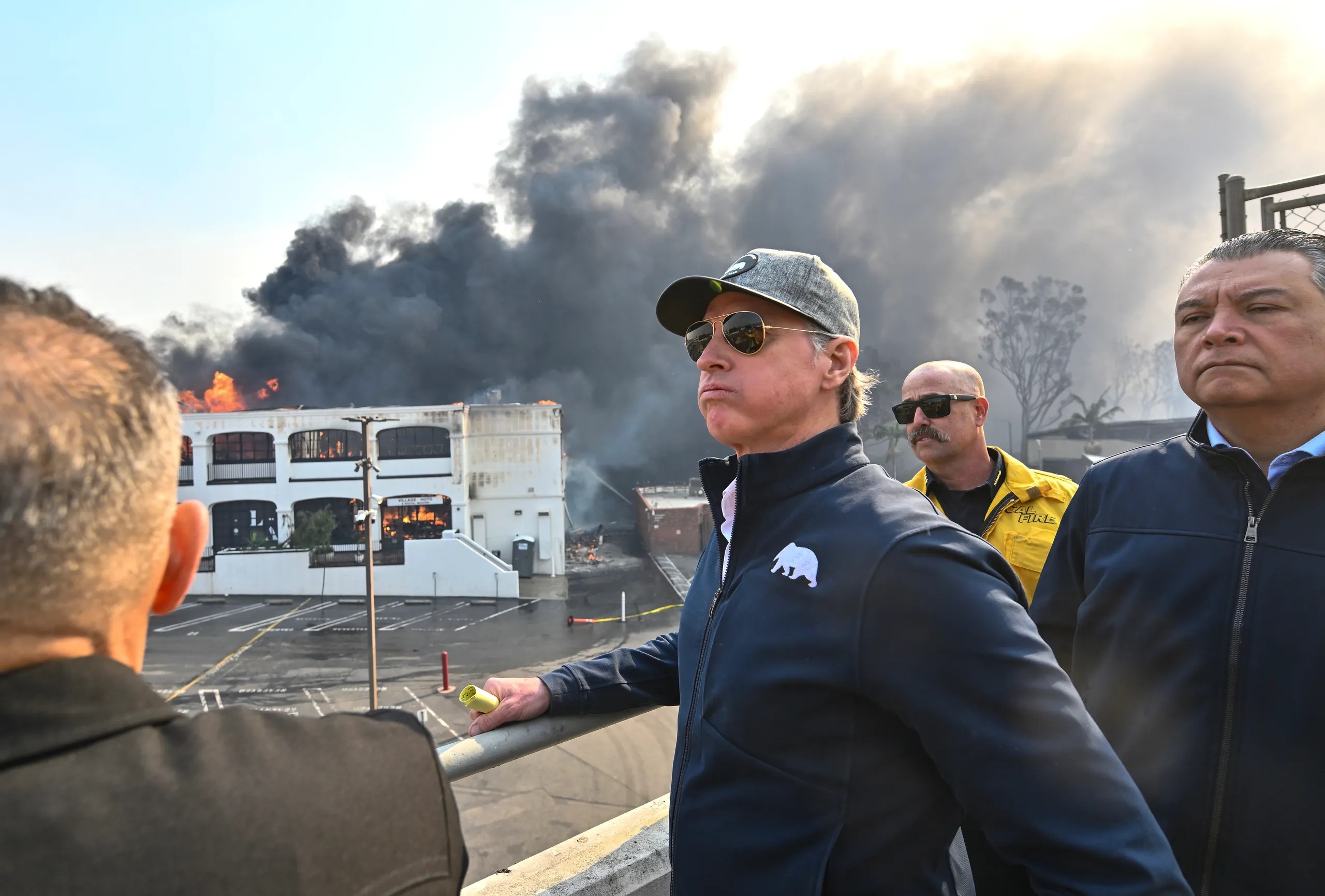
Governor Gavin Newsom has faced intense criticism for his handling of water resources in the state. He has been accused of refusing to replenish key reservoirs across California, opting instead to let millions of gallons of excess rainfall and snowmelt flow into the Pacific Ocean. Critics argue that these resources could have been pivotal in mitigating the current emergency, highlighting a clash between environmental policies and practical disaster preparedness.

The devastation of entire residential neighbourhoods has also sparked questions about the effectiveness of containment strategies. Videos circulating online show firefighters directing water onto homes engulfed in flames and already destroyed instead of prioritizing efforts to protect intact ones, which could have slowed the fire’s spread. In some clips, crews are even seen using buckets to douse flames—an almost surreal display that underscores the inadequacy of the response.
These operational decisions have raised broader concerns about leadership effectiveness and the criteria used for key appointments. Some argue that recent leadership selections have prioritized ideological considerations—such as diversity quotas—over proven competence in crisis management. Critics suggest this trend is particularly pronounced in California, where “woke” ideology has reportedly influenced key appointments at the expense of meritocracy.
The wildfires have laid bare systemic issues that extend beyond environmental factors. They highlight the urgent need for comprehensive reform in both disaster preparedness and governance. As Californians grapple with the aftermath, public demand for accountability and competence in leadership grows louder, underscoring the importance of prioritizing safety and resilience over political and ideological considerations.

Last year, the head of the Los Angeles Fire Department (LAFD) announced the adoption of a hiring policy grounded in the principles of Diversity, Equity, and Inclusion (DEI). Identifying as a “proud member of the LGBTQ+ community,” the chief emphasized that implementing diversity quotas was her top priority. Her leadership has been marked by active participation in events such as Pride parades and the introduction of mandatory training programs focused on inclusion, respect for diversity, and combating bias. While these initiatives may be commendable from a social perspective, questions have arisen about whether they might interfere with the essential technical training required for frontline firefighting personnel.
Criticism has grown regarding the management of resources and the LAFD’s priorities. The chief’s decision to support a $17.5 million budget reduction raised concerns. Compounding the issue, the Los Angeles City Council redirected part of the fire department’s budget and surplus equipment to support Ukraine—a move that sparked controversy given the increasing fire risk in the region.
The Pacific Palisades fire and the challenges faced in managing it highlight the urgent need to reassess priorities, resource allocation, and personnel preparedness. Effectively responding to emergencies requires a careful balance between social awareness and technical expertise, ensuring that one does not come at the expense of the other.
Many are wondering whether countries prone to wildfires would experience devastation on the scale of the wildfires currently ravaging California. Take Italy, for example: although it also faces wildfire risks, its proactive approach to land management and robust construction practices significantly reduce the likelihood of such a disaster. A comparison between the strategies of the United States and Italy highlights key differences in prevention measures, land management techniques, and safety policies.

Italy takes a proactive approach to fighting wildfires, aiming to prevent their spread as quickly as possible. Measures like firebreaks and controlled burns are particularly effective when implemented alongside early warning systems and real-time fire behavior monitoring. Additionally, the use of specially trained volunteers strengthens local response capabilities. Community involvement is a cornerstone of Italy’s strategy, where collective effort plays a crucial role.

Firebreaks—strips of land cleared of vegetation and flammable materials—are an effective method for reducing available fuel and creating a barrier that fire cannot cross. Another proactive technique used in Italy is prescribed or controlled burns, which involve intentionally setting fire to an area before a wildfire reaches it. Since already burned material cannot reignite, this creates a buffer zone capable of halting the fire’s advance.
One key factor distinguishing Italy is its land management. In Italy, cities are typically compact, with a clear separation between urban areas, woodlands, and forests. Furthermore, practices like creating firebreaks and controlling vegetation around homes are well-established. This organization helps limit the spread of fires from forests to populated areas.
By contrast, in California, many homes are built in hilly or forested areas surrounded by dense vegetation, which serves as ideal fuel for wildfires.
The materials used in construction represent another stark difference. In California, homes—luxury villas included—are often built with highly flammable materials like wood. This choice, driven by cost efficiency and construction speed, poses significant fire risks. Wood offers no natural barrier against flames, and while fire-resistant building codes have been introduced, they are frequently ignored or inadequately enforced. As a result, California’s homes are dramatically vulnerable to wildfires, contributing to widespread destruction during fire outbreaks.
In contrast, Italy has a long-standing tradition of building with fire-resistant materials such as concrete, bricks, stone, and marble. These materials not only ensure greater durability but also serve as a natural barrier against flames. In an Italian home, a well-sealed, windowless room can become a safe refuge during a wildfire, minimizing the risk of toxic smoke inhalation—a leading cause of death in wildfires. This construction tradition makes Italian buildings significantly safer in emergencies.
Italy exemplifies how careful land management and robust construction practices can drastically reduce wildfire risks. The challenge ahead will be maintaining these best practices in an ever-evolving environmental landscape.
Desidera solo che il Dipartimento dei Vigili del Fuoco di Los Angeles avesse messo lo stesso impegno che ha messo lui.
Carr ha detto: “Se avessero avuto qualche camion dei pompieri e avessero dato un paio di spruzzate qua e là, tenendo d’occhio la situazione, tutte queste case sarebbero ancora qui adesso. Ve lo dico chiaramente, l’ho visto con i miei occhi. Tutte queste case. Le case dietro di me, sono tutte sparite. È iniziato con una piccola scintilla, un piccolo incendio. Se li avessero spenti subito, con qualche persona lì, sarebbero ancora tutte qui.”
 Italia ri-unita